MLB · 1954Vintage Set Guide

Hank Aaron's rookie, Ted Williams' bookends and a landmark vintage set

1954 Topps Baseball: Hank Aaron's Rookie, Ted Williams' Bookend Cards and a Landmark Vintage Set

A 250-card release with bold colors, dual player images and one of the most important rookie classes in baseball card history.

The 1954 Topps Baseball set helped establish the look and feel of modern baseball cards. Its bold colors, oversized team logos, facsimile autographs and dual player images made the cards stand out from earlier releases, filling nearly every inch of cardboard with photography, graphics and player information.

The 250-card checklist also features one of the most important rookie classes in hobby history. Hank Aaron, Ernie Banks and Al Kaline all make their Topps debuts, while Ted Williams appears on both the first and final cards in the set. Willie Mays, Jackie Robinson, Yogi Berra, Whitey Ford and Warren Spahn add even more Hall of Fame talent.

The set arrived during the intense competition between Topps and Bowman, when player contracts influenced which stars appeared in each company's releases. Mickey Mantle is notably absent, but Topps made the most of its own star power with Williams and a memorable lineup of rookies and established legends.

Hank Aaron #128 · NM-MT+ 8

Free portfolio

Follow the players in this set.

Build your free portfolio to track their Players Invest Scores, card sales and market momentum every day.

Browse athletes

Set overview

Inside the 1954 Topps Baseball set

The 1954 Topps Baseball set contains 250 cards, each measuring approximately 2⅝ by 3¾ inches. At the time, this larger format helped Topps distinguish its cards from competing products and establish a size that would influence the hobby for years to come.

The set was issued in multiple series. Cards #1–50 made up the first series, cards #51–75 formed a shorter second series, and cards #76–250 completed the checklist. The #51–75 group is generally considered somewhat more difficult to find, although the set has no widely recognized group of extremely elusive numbers.

The design is the set's defining feature. Each card combines a large color portrait with a smaller image of the same player in a posed or action-oriented position. A prominent team logo identifies the franchise, while the player's name, position, team and facsimile autograph complete the front.

The bright background colors make the cards instantly recognizable. Yellow, light blue, green, red, orange and white are among the colors used throughout the set, creating a vivid collection of individual player portraits.

The card backs are equally detailed, with biographical information, career notes, statistics and small cartoon sequences. The green coloring on the reverse is an important part of the design, and wear along the back edges can be noticeable on surviving examples.

One unusual feature comes from the original printing and cutting process. The cards were arranged top-to-top on the printing sheets, which helps explain why the finished cards have no colored border along the top edge. This can make some cards appear miscut at first glance, but the design is intentional.

Checklist

250 cards

Card size

2⅝ × 3¾ in

Distribution

Three series

Tougher group

#51–75

The key rookie cards

Aaron, Banks and Kaline headline the rookie class

Hank Aaron, Ernie Banks and Al Kaline give the checklist one of the strongest groups of Hall of Fame rookie cards of the 1950s.

Hank Aaron #128 1954 Topps
Rookie card#128NM-MT+ 8

Hank Aaron

1954 Topps

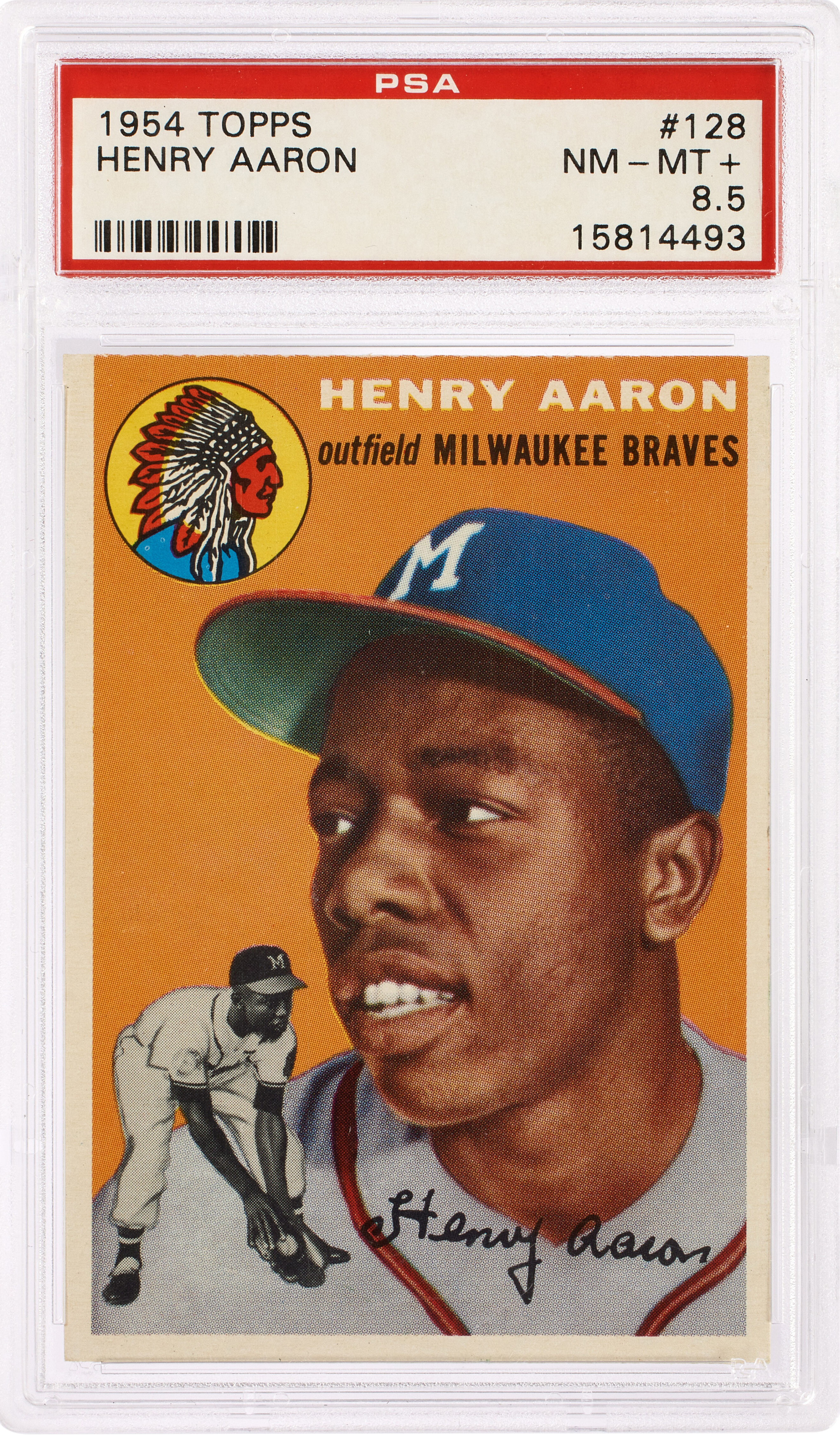
Hank Aaron's 1954 Topps #128 is the set's signature rookie card and one of the most important cards in postwar baseball collecting. It features Aaron as a young Milwaukee Braves player, with a color portrait and a smaller action image set against a vibrant background.

It captures the beginning of a career that would eventually include 755 home runs, a National League MVP award and a World Series championship, and its distinctive design makes it recognizable even outside the vintage-card community.

Condition plays a major role in its value. Centering, print quality, corner wear and the condition of the card back can all affect a copy's appeal, and even cards with relatively sharp corners may have surface defects or centering issues that influence their grade.

PSA CardFacts reports a recent sale of $600,000 for a PSA MINT 9 example and a recent sale of $357,594 for a PSA GEM MT 10 example, with a listed PSA price-guide figure of $480,000 for a PSA 9. These figures reflect exceptional graded examples and should not be used to estimate the value of lower-grade or ungraded copies.

Aaron #128 is the natural centerpiece of a 1954 Topps collection, and a card where authentication, grade verification and comparisons with recent sales are especially important.
Ernie Banks #94 1954 Topps
Rookie card#94MINT 9

Ernie Banks

1954 Topps

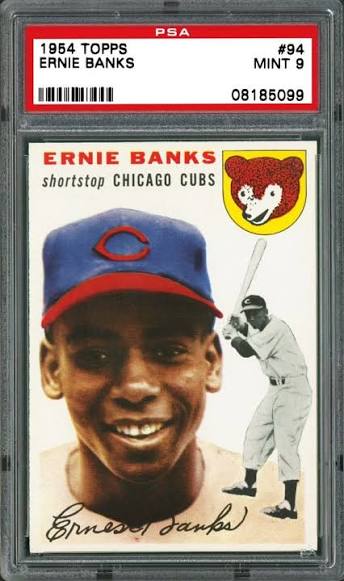
Ernie Banks' #94 card is another major rookie from the set. Known as "Mr. Cub," Banks became one of the most celebrated players in Chicago Cubs history, earning two National League MVP awards and a place in the Baseball Hall of Fame.

His rookie card is a natural companion to Aaron's for collectors building around the great players who entered the hobby during the 1950s, and it also appeals to Cubs fans and collectors of Hall of Fame rookies.

As with Aaron, condition and eye appeal matter. Look closely at centering, surface quality and the card's edges before comparing prices, and let the exact grade and recent comparable sales guide any purchase.

Al Kaline #201 1954 Topps
Rookie card#201MINT 9

Al Kaline

1954 Topps

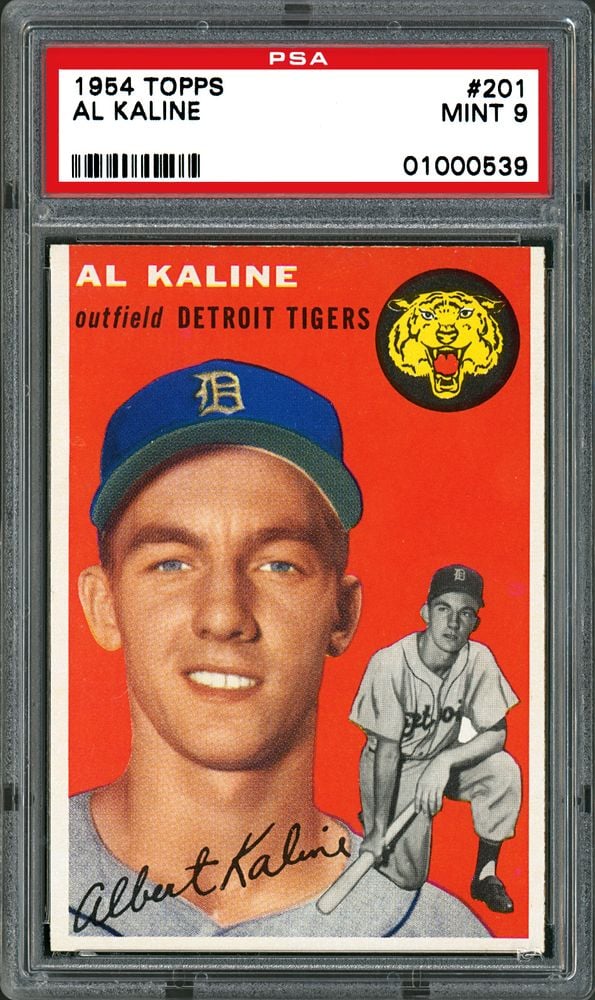
Al Kaline's #201 rookie card is another key attraction. Kaline spent his entire major league career with the Detroit Tigers and became one of the franchise's defining players, with a combination of hitting, defense and longevity that earned him Hall of Fame recognition.

The card has particular appeal to Tigers collectors, vintage rookie-card collectors and fans building a collection around the game's all-time greats.

Alongside Aaron and Banks, Kaline gives the 1954 checklist an unusually strong group of Hall of Fame rookies. Collectors can pursue the three together as a focused collection or use them as the foundation for a broader set build.

Established stars

Mays, Robinson, Berra and the rest of the checklist

The 1954 checklist includes a strong selection of established stars. Willie Mays, Jackie Robinson and Yogi Berra sit alongside Whitey Ford #37, Warren Spahn #20, Gil Hodges, Duke Snider, Frank Robinson and other notable players, giving collectors plenty of options beyond the headline rookies.

Willie Mays #90 card
#90MINT 9

Willie Mays

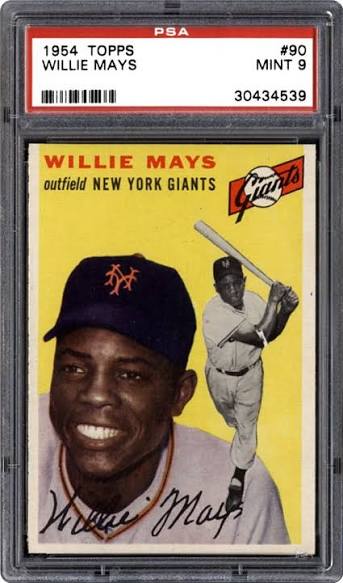
The card features Mays during his years with the New York Giants, shortly before the team won the 1954 World Series against Cleveland, the season of his famous over-the-shoulder catch of Vic Wertz's deep drive in Game 1.

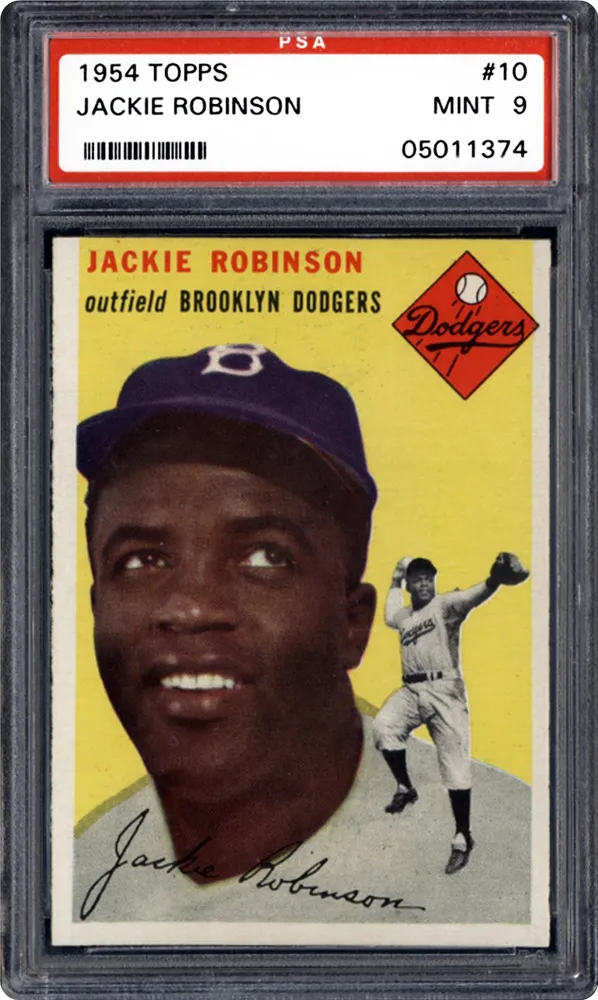
Jackie Robinson #10 card
#10MINT 9

Jackie Robinson

A major target for collectors of baseball history. Robinson's place in the game's integration story gives his cards significance beyond his on-field accomplishments.

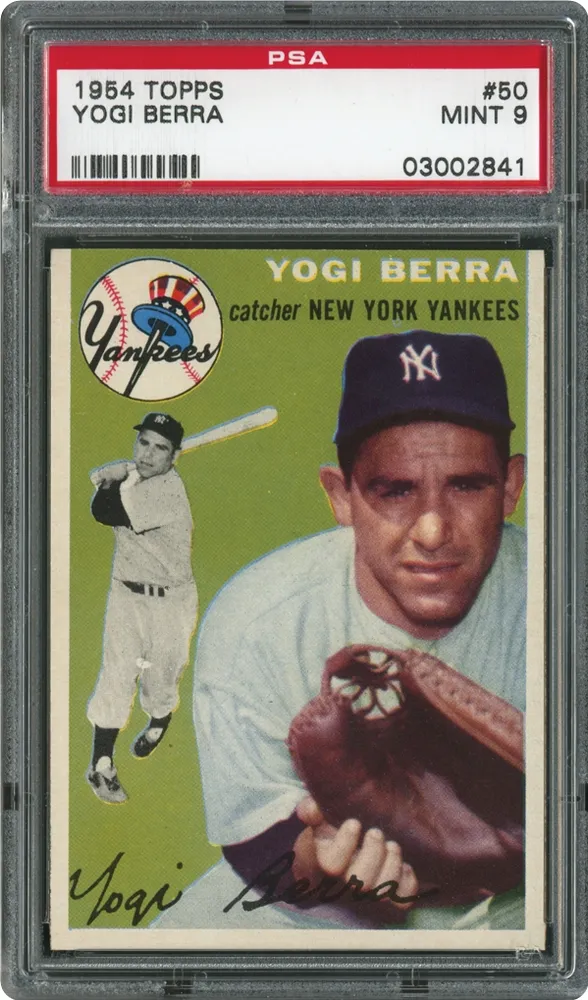
Yogi Berra #50 card
#50MINT 9

Yogi Berra

The Yankees catcher and multi-time MVP. Whitey Ford #37 represents another key member of the Yankees dynasty, while Warren Spahn #20 is a notable card of one of the greatest left-handed pitchers in baseball history.

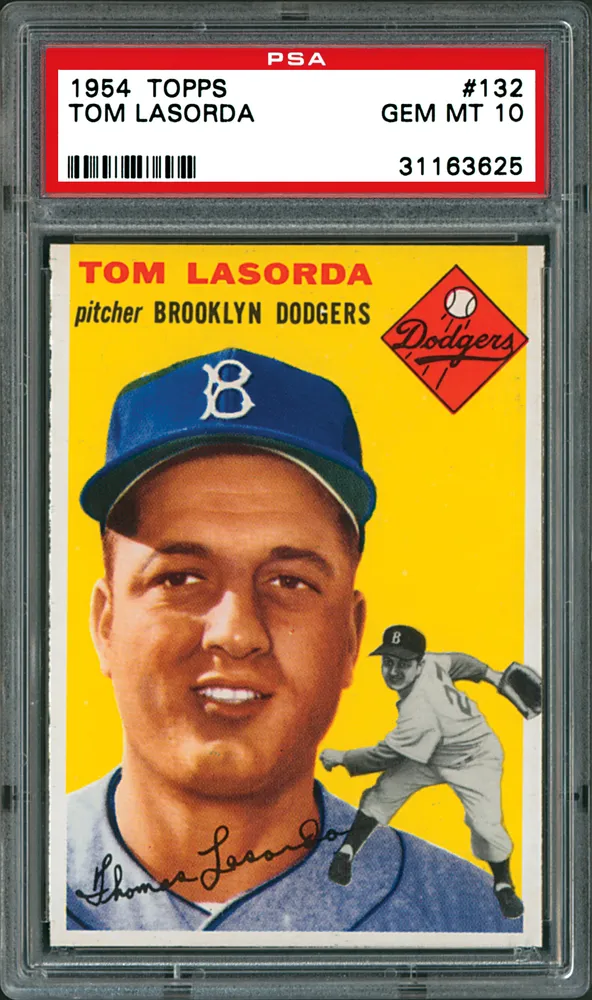
Tommy Lasorda #132 card
#132GEM MT 10

Tommy Lasorda

Lasorda appears here years before becoming famous as the longtime manager of the Los Angeles Dodgers, an interesting target for collectors who focus on managers as well as players.

Ted Williams #1 and #250

The bookends of the set

Topps made a statement by placing Ted Williams on both the first and last cards of the checklist. Williams had returned to baseball after serving as a Marine Corps pilot during the Korean War, and his appearance gave Topps a marquee star around which it could build the release.

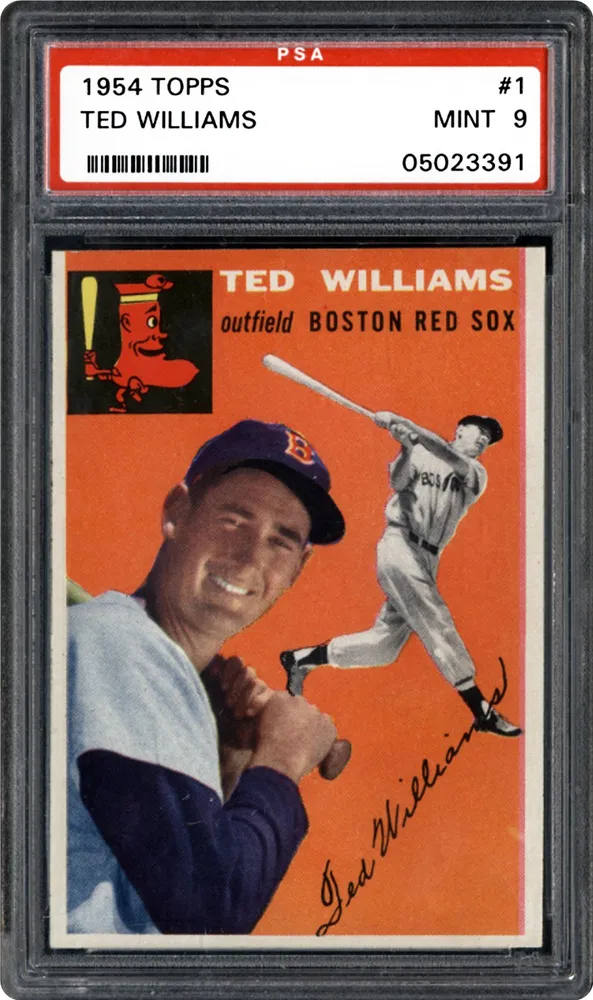
Ted Williams #1 card
#1MINT 9

Ted Williams

The #1 card opens the set with Williams in a bold design featuring an orange background. Its position at the beginning of the checklist also made it vulnerable to wear from handling and storage.

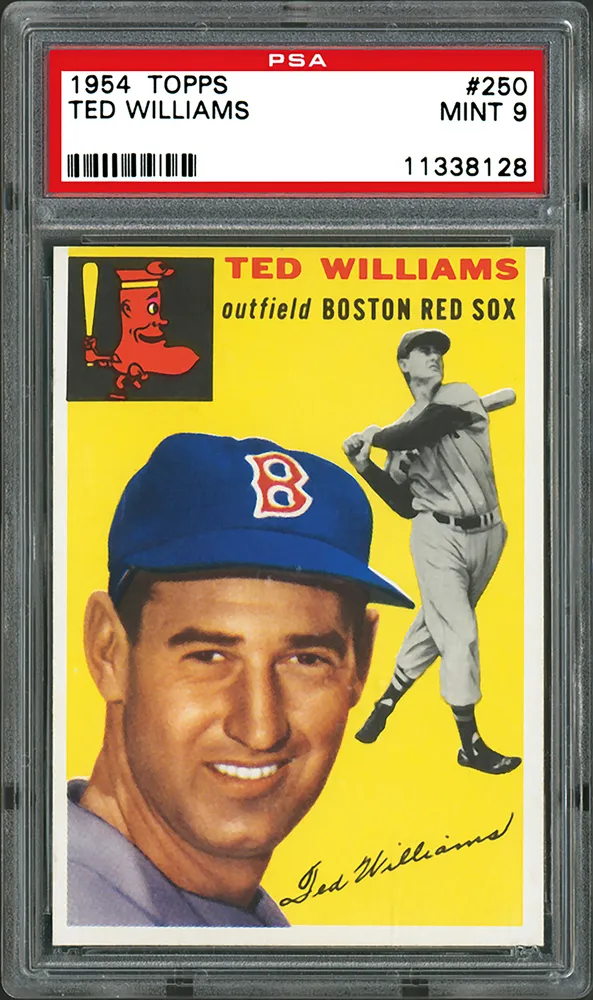
Ted Williams #250 card
#250MINT 9

Ted Williams

The #250 card closes the set with a different Williams image and a yellow background. Its reverse includes a longer cartoon-style narrative, adding another distinctive detail to the card.

Which Williams card is tougher?

For years, collectors often regarded #250 as the tougher of the two Williams cards. Graded-card population information has complicated that assumption, so collectors should compare the actual grade, condition and market evidence rather than automatically treating one card as scarcer.

PSA CardFacts lists a recent sale of $32,400 for a PSA MINT 9 example of #250, with a PSA price-guide figure of $30,000. For #1, PSA reports a recent PSA 9 sale of $46,111.20, while its listed price-guide figure for that grade is $106,500. Those differences show why recent sales and price-guide estimates should be considered separately.

Together, the two cards give the set one of its most memorable collecting features. They are essential targets for set builders and natural choices for collectors who specialize in Williams.

The fine print

Mantle's absence, printing errors and Canadian backs

The absence of Mickey Mantle remains one of the set's most discussed omissions. During the competition between Topps and Bowman, player contracts and licensing arrangements affected which players appeared in each company's products. Mantle remained associated with Bowman for the 1954 release, leaving Topps without one of the era's biggest names. Topps responded by emphasizing Williams and the many other stars it could feature.

The set also includes cards with printing and identification errors. Preacher Roe #14 has a misspelling on the back, while Bill Glynn #178 has his surname misspelled on the front. Johnny Lipton #19 has conflicting team information between the front and back. These details can interest error collectors, although not every printing error commands a premium.

The checklist extends beyond the best-known Hall of Fame rookies. It includes coaches, managers and players whose major league careers were less prominent, entries that complete the checklist and reflect the way early Topps sets combined stars with a broader selection of baseball personnel.

Early-series cards need care when identifying versions. Cards #1–50 were also issued in Canada with gray backs, unlike the white-backed American versions, and they should be identified correctly when researching listings and comparing prices.

Checklist

250 cards

Second series

#51–75

Canadian backs

#1–50

Named errors

3 cards

How the bookends compare

Ted Williams #1 vs. #250

Both cards are essential to the set, but their positions on the checklist created different collecting challenges.

#1 — the opener

  • First card in the checklist
  • Bold orange background
  • Vulnerable to handling and storage wear
  • Recent PSA 9 sale of $46,111.20 against a $106,500 guide

#250 — the closer

  • Final card in the checklist
  • Yellow background with print defects worth checking
  • Longer cartoon-style narrative on the reverse
  • Recent PSA 9 sale of $32,400 against a $30,000 guide

Long-standing collector opinion favored #250 as the tougher card, but graded population data complicates that view. Compare the exact grade, condition and recent sales instead of assuming one is scarcer.

What moves the price

What affects 1954 Topps Baseball card values?

The value of a 1954 Topps card depends on the player, card number, condition, grade and collector demand. The major rookie cards and Ted Williams bookends attract substantial attention, while the broader checklist offers many more affordable ways to collect the set.

Hank Aaron #128 is the set's signature card, with exceptional graded examples reported at $600,000 in PSA 9 and $357,594 in PSA 10 against a $480,000 PSA 9 guide figure. Ted Williams #1 has a recent PSA 9 sale of $46,111.20 and #250 a recent PSA 9 sale of $32,400. Ernie Banks #94, Al Kaline #201, Willie Mays #90, Jackie Robinson #10 and Yogi Berra #50 all trade on grade, centering and eye appeal, so compare recent completed sales for the exact card and grade.

Price information is based on PSA CardFacts and can change as new sales are recorded. The figures shown for high-grade cards are not estimates for raw or lower-grade copies.

Before buying or selling, confirm the exact card number and grade, then compare recent completed sales. Price guides can provide a useful reference, but actual transactions may differ substantially. For ungraded cards, examine clear images of both the front and back and avoid relying solely on a seller's condition description.

Condition challenges

Why condition matters in 1954 Topps

Centering: cards can be off-center, affecting the balance of the portrait and surrounding graphics.

Corner and edge wear: the larger format can show handling damage clearly.

Back chipping: the green coloring on the reverse can reveal edge wear and small areas of loss.

Print defects: spots, ink marks and other production flaws can interrupt the bright backgrounds.

Surface condition: scratches, stains and other imperfections can reduce eye appeal.

Storage damage: cards stored together or handled frequently may show wear, particularly around the edges.

The Ted Williams bookend cards deserve close inspection because their positions at the beginning and end of the checklist made them vulnerable to handling. For #250, pay attention to the yellow background and any print defects that affect the appearance.

The set's lack of extremely scarce numbers does not make a complete set easy to assemble in high grade. Finding all 250 cards is one challenge; finding them with consistent centering, clean surfaces and minimal wear is another.

Collecting tips

Building the set

If you're starting a 1954 Topps collection, decide whether your goal is the complete 250-card set or a focused group of key cards.

A rookie-card collection built around Hank Aaron #128, Ernie Banks #94 and Al Kaline #201 is a natural starting point. Add Ted Williams #1 and #250 to capture the set's bookends, then consider Willie Mays #90, Jackie Robinson #10, Yogi Berra #50 and Whitey Ford #37.

If you want the complete set, keep an eye on cards #51–75, which are considered somewhat more difficult to find. Condition should be a priority throughout the checklist, particularly if you're aiming for a consistent collection.

Be sure to verify the version when buying early-series cards. Cards #1–50 were also issued in Canada with gray backs, unlike the white-backed American versions, and should be identified correctly when researching listings and comparing prices.

Finally, maintain a checklist with card numbers, condition notes, grades and purchase prices. That makes it easier to identify gaps, compare sales and avoid confusing different versions or grades.

Price guide

1954 Topps Baseball price context

Reported PSA CardFacts figures for the set's headline cards. They are reference points drawn from the cited sales rather than guaranteed current selling prices.

R = rookie card · HOF = Hall of Famer

CardNo.Recent PSA 9PSA 9 guideRecent PSA 10
Hank Aaron (R, HOF)#128$600,000$480,000$357,594
Ted Williams (HOF)#1$46,111.20$106,500—
Ted Williams (HOF)#250$32,400$30,000—

Figures follow the reported PSA CardFacts data and may change as new sales are recorded. The Aaron PSA 10 result is listed as reported. These are not estimates for raw or lower-grade copies, and cards such as Ernie Banks #94, Al Kaline #201, Willie Mays #90, Jackie Robinson #10 and Yogi Berra #50 should be compared against recent completed sales for the exact grade.

Why 1954 Topps Baseball belongs on a collector's checklist

The 1954 Topps Baseball set marks an important point in the development of the hobby. Its large format, bright backgrounds, dual images and detailed card backs helped establish a visual style that collectors still recognize today.

The checklist is equally compelling. Hank Aaron, Ernie Banks and Al Kaline headline a powerful rookie class, while Ted Williams' #1 and #250 cards frame the set with one of its most distinctive features. Willie Mays, Jackie Robinson, Yogi Berra and the other stars make the remaining cards rewarding to explore.

Whether you're chasing Aaron's rookie, collecting the Ted Williams bookends or working toward all 250 cards, 1954 Topps offers a combination of baseball history, iconic design and vintage collecting challenges.

We use cookies

Players Invest uses essential cookies to run the site, plus analytics and advertising cookies to understand how visitors use it and to measure our marketing. You can accept or decline the non-essential ones. Privacy Policy