NFL · 1972Vintage Set Guide

Hall of Fame rookies, scarce high numbers and hobby firsts

1972 Topps Football: A Set Defined by Hall of Fame Rookies, Scarce High Numbers and Hobby Firsts

351 cards, a loaded rookie class led by Roger Staubach, the first Topps football leader cards, the debut of Pro Action, and a third series that has frustrated set builders for generations.

The 1972 Topps Football set is one of the most significant vintage football releases of the decade. Its 351 cards bring together an impressive collection of Hall of Fame players, major rookie cards and a difficult final series that has made completing the set a challenge for collectors for generations.

The set is especially notable for its first Topps football leader cards, its introduction of the Pro Action subset, and the rookie cards of Roger Staubach, John Riggins and Ted Hendricks.

It also marks the final vintage Topps football release distributed in multiple series, giving the set a place in the hobby's history beyond its star power.

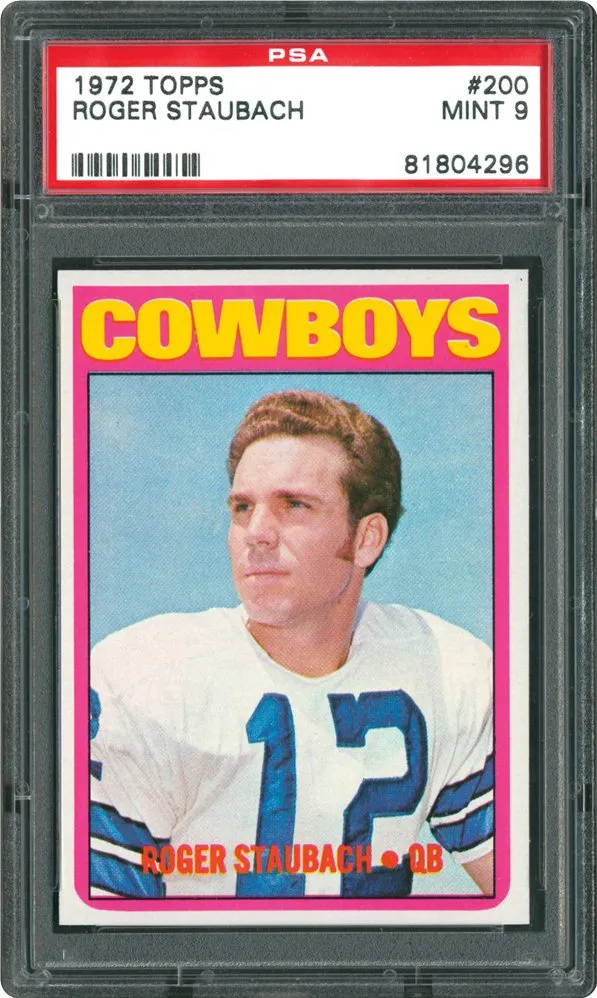
Roger Staubach #200 · Rookie card · MINT 9

Free portfolio

Follow the players in this set.

Build your free portfolio to track their Players Invest Scores, card sales and market momentum every day.

Browse athletes

Set overview

Inside the 1972 Topps Football set

Topps released the set in 1972 across 351 cards, each measuring 2½ by 3½ inches, distributed in three series.

The third series, cards #264–351, is the most difficult run in the set. It was released in much smaller quantities and reportedly distributed in only select parts of the country.

The checklist carries the set's key rookie at #200 and a deep run of Hall of Fame talent behind it.

Manufacturer

Topps

Release year

1972

Total cards

351

Series

Three

Hardest series

#264–351

Key rookie

Roger Staubach #200

Subsets

Leaders · Pro Action · Playoffs · All-Pro

Key rookie cards

Staubach and a deep Hall of Fame class

The 1972 set features an outstanding rookie class, led by Roger Staubach and supported by several other future Hall of Famers.

Roger Staubach #200 1972 Topps Football
Rookie card · Signature card#200MINT 9

Roger Staubach

1972 Topps Football

Staubach's #200 rookie is the centerpiece. It is one of the most recognizable vintage football rookie cards, and its condition challenges make high-grade examples especially desirable.

Hall of Fame quarterback and the set's premier rookie, it sits right at the point where the first two series give way to the difficult high numbers.

Centering is the story on this card. Its position on the original printing sheet may have contributed to the problem, so shop by eye before price.

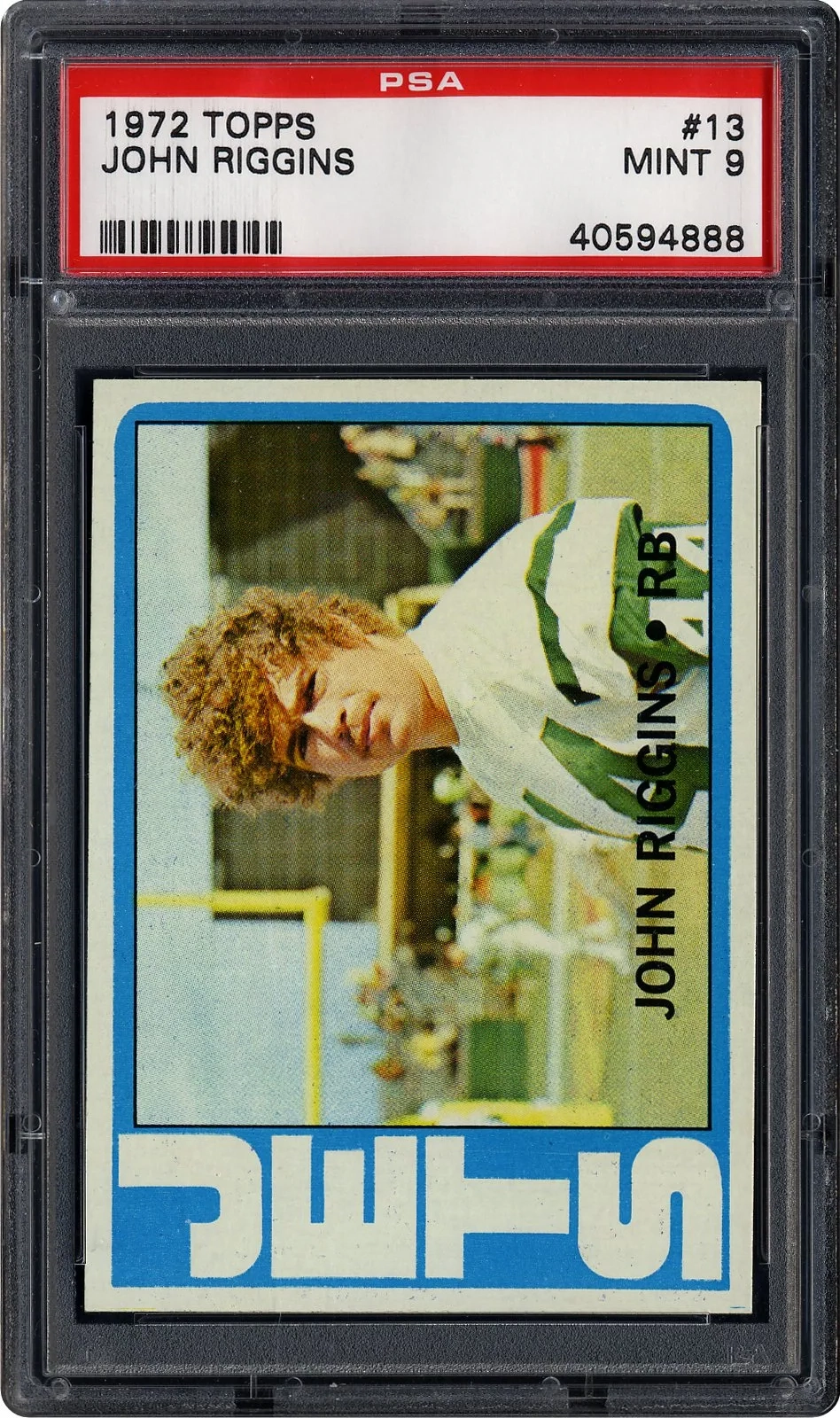
John Riggins #13 1972 Topps Football
Rookie card · Hall of Famer#13MINT 9

John Riggins

1972 Topps Football

Hall of Fame running back rookie, and an early number in the checklist. The portrait sits inside the light blue Jets frame with the player name and position running vertically along the right edge.

An early-series card, so it is one of the more obtainable Hall of Fame rookies in the set. The picture grade is a MINT 9.

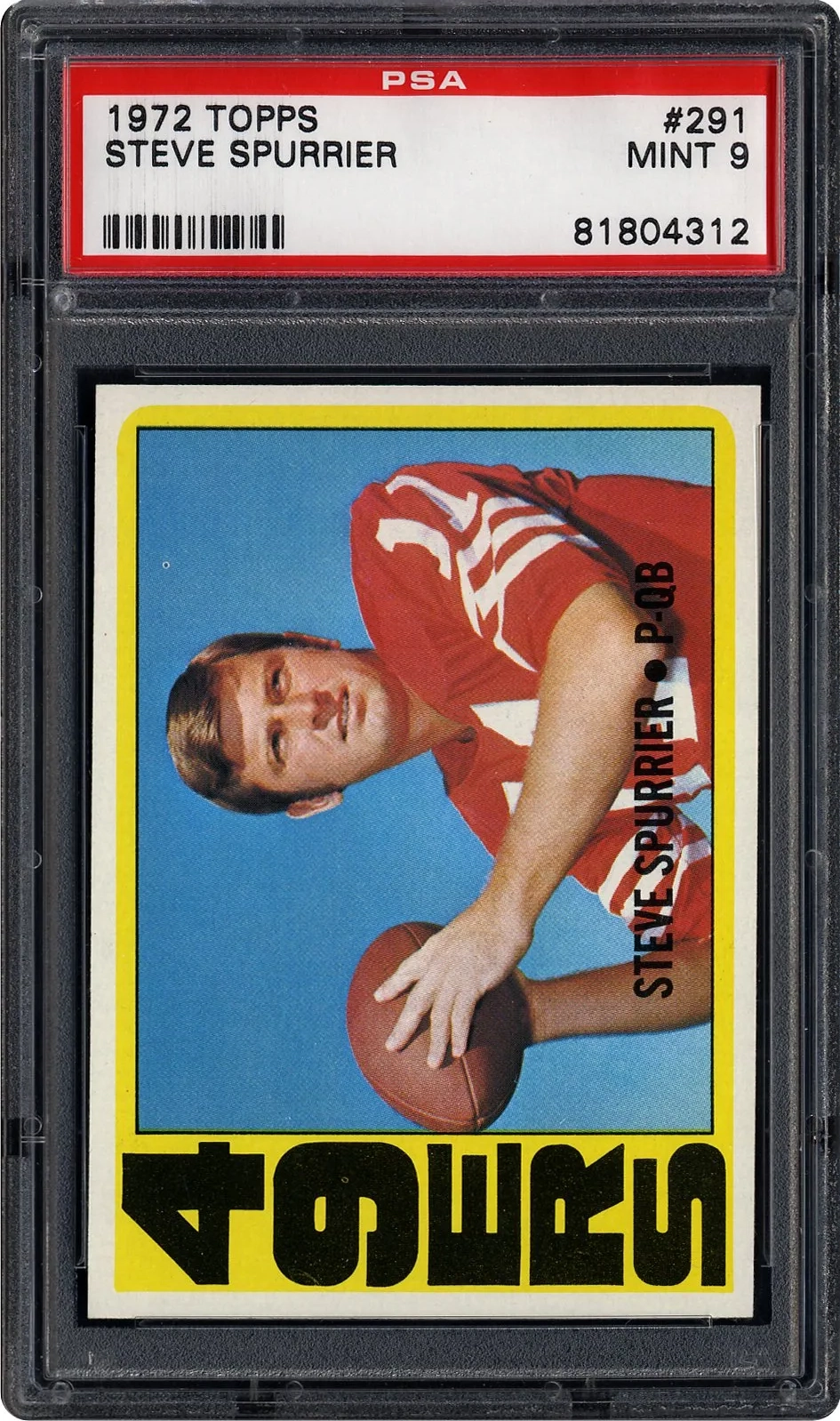
Steve Spurrier #291 1972 Topps Football
Rookie card · High number#291MINT 9

Steve Spurrier

1972 Topps Football

A popular rookie from the difficult third series, shown in a red 49ers jersey against the set's yellow frame.

Third-series scarcity means even a modest rookie carries a premium. A MINT 9 from that range is a real find.

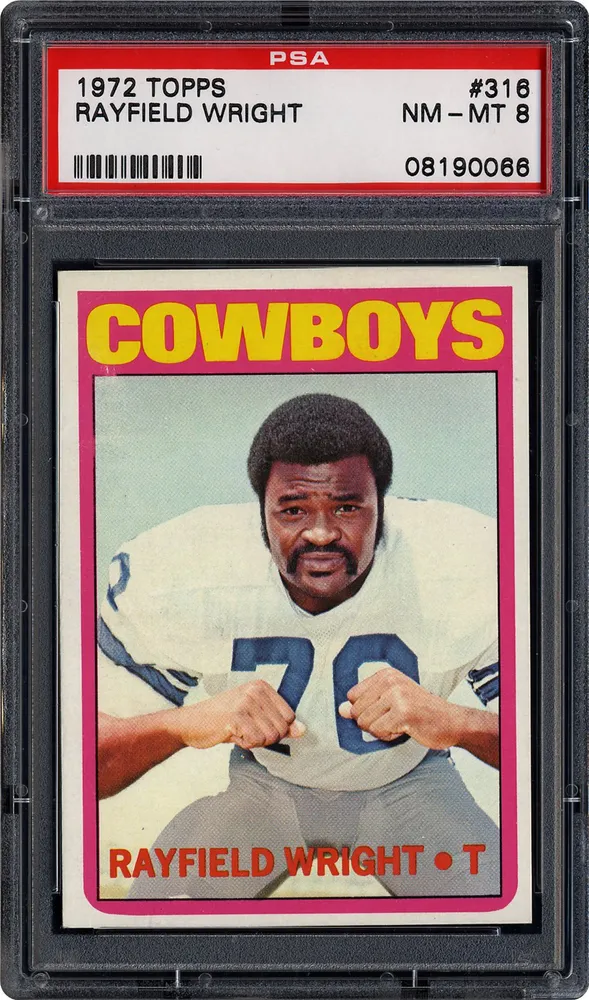
Rayfield Wright #316 1972 Topps Football
Rookie card · Hall of Famer · High number#316NM-MT 8

Rayfield Wright

1972 Topps Football

Hall of Fame offensive tackle rookie and a difficult high number, known for centering problems. The pink Cowboys frame makes an off-center copy obvious.

One of the two or three toughest keys in the third series. Most collectors settle for an 8 rather than chase a 9.

Notable rookies#93 · #104 · #157 · #186 · #240 · #244

Other Hall of Fame rookies

1972 Topps Football

Ted Hendricks #93: Hall of Fame linebacker rookie.

Ron Yary #104: Hall of Fame offensive tackle rookie.

Emmitt Thomas #157: Hall of Fame defensive back rookie.

Gene Upshaw #186: Hall of Fame offensive lineman rookie.

Larry Little #240: Hall of Fame offensive lineman rookie.

Charlie Joiner #244: Hall of Fame wide receiver rookie.

Also notable: Archie Manning #55, Jim Plunkett #65 and Lyle Alzado #106, three quarterback and defensive line rookies that collectors chase beyond the Hall of Fame names.

Yary, Little and Joiner land in the upper part of the second series, where the supply thins before the third series really starts.

Hall of Fame stars and notable veterans

The veteran checklist behind the rookies

Beyond the rookie class, the set features an impressive lineup of established stars and legendary players.

#100

Joe Namath

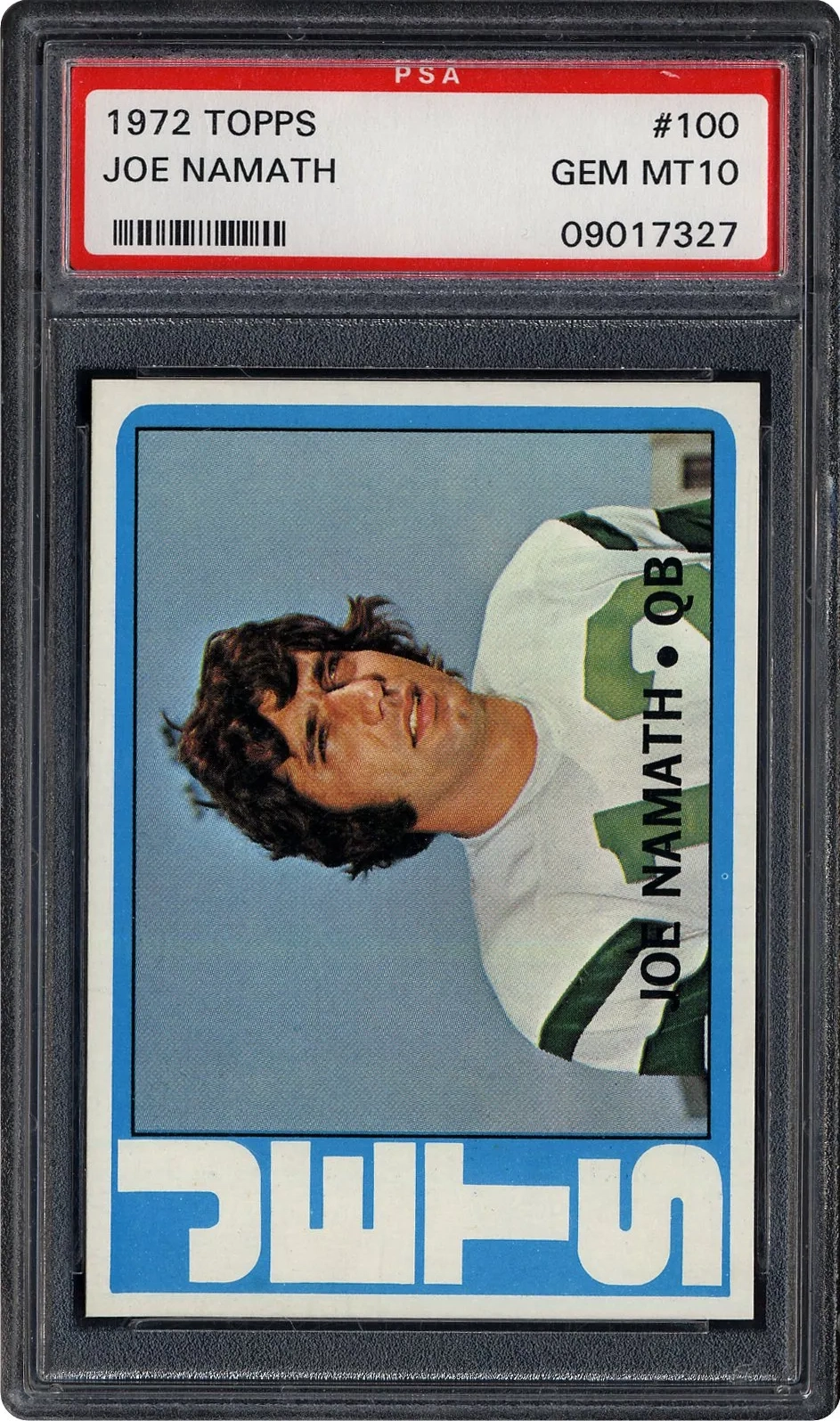
The set's marquee veteran quarterback.

#110

Gale Sayers

His final Topps card.

#150

Terry Bradshaw

Early-career Steelers quarterback card.

#160

O.J. Simpson

Bills running back.

#165

Johnny Unitas

Late-career Colts card.

#170

Dick Butkus

Bears linebacker.

#190

Bubba Smith

Colts defensive lineman.

#225

Fran Tarkenton

Vikings quarterback.

#230

Joe Greene

Steelers defensive tackle.

#235

George Blanda

Raiders kicker and quarterback.

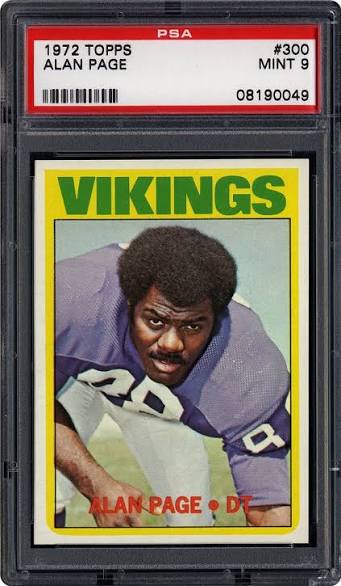
#300

Alan Page

Vikings Hall of Fame defensive tackle, high number.

The key cards up close

Namath, Butkus, Bradshaw and the high numbers

The cards collectors chase first, including two Pro Action examples from the scarce third series.

Joe Namath #100 card
#100GEM MT 10

Joe Namath

The set's marquee veteran. The light blue frame with the heavy white JETS lettering is one of the most familiar images in vintage football. A gem-mint 10 is exceptional for a 1972 card.

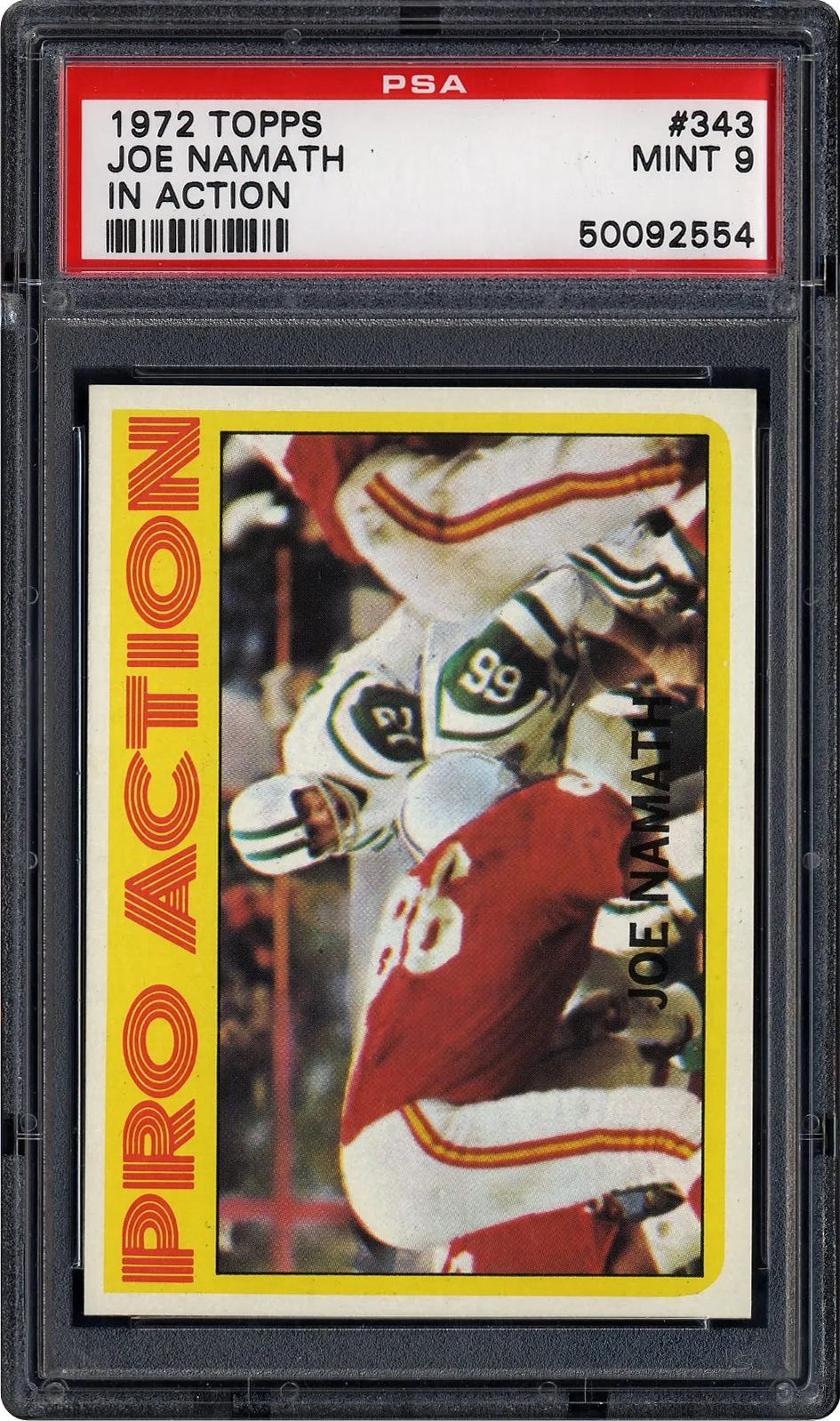
Joe Namath · Pro Action #343 card
#343MINT 9

Joe Namath · Pro Action

One of the most sought-after cards in the set and one of the most desirable high-number action cards. Note the PRO ACTION header stacked down the left side in alternating orange and red.

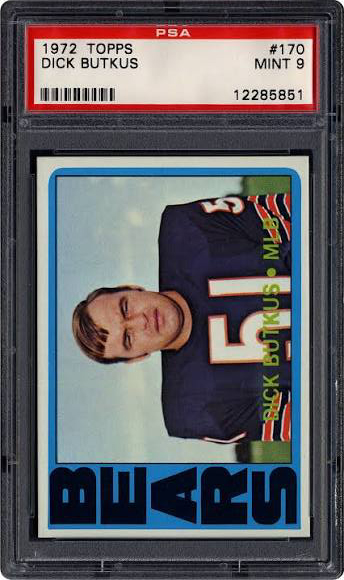
Dick Butkus #170 card
#170MINT 9

Dick Butkus

Bears linebacker inside the light blue frame with the lime-green player ID running vertically. Sharp player photography is one of the set's real strengths. His Pro Action card at #341 is the third-series companion to this one.

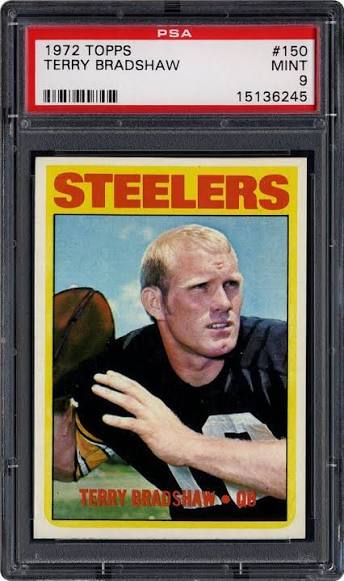
Terry Bradshaw #150 card
#150MINT 9

Terry Bradshaw

Another standout, capturing the Steelers quarterback early in his championship-era career. The yellow frame with STEELERS across the top is one of the most collectible team treatments in the set.

Alan Page #300 card
#300MINT 9

Alan Page

A high-number card of the Vikings Hall of Fame defensive tackle, photographed in a three-point stance. Landing at #300 puts it inside the scarce run.

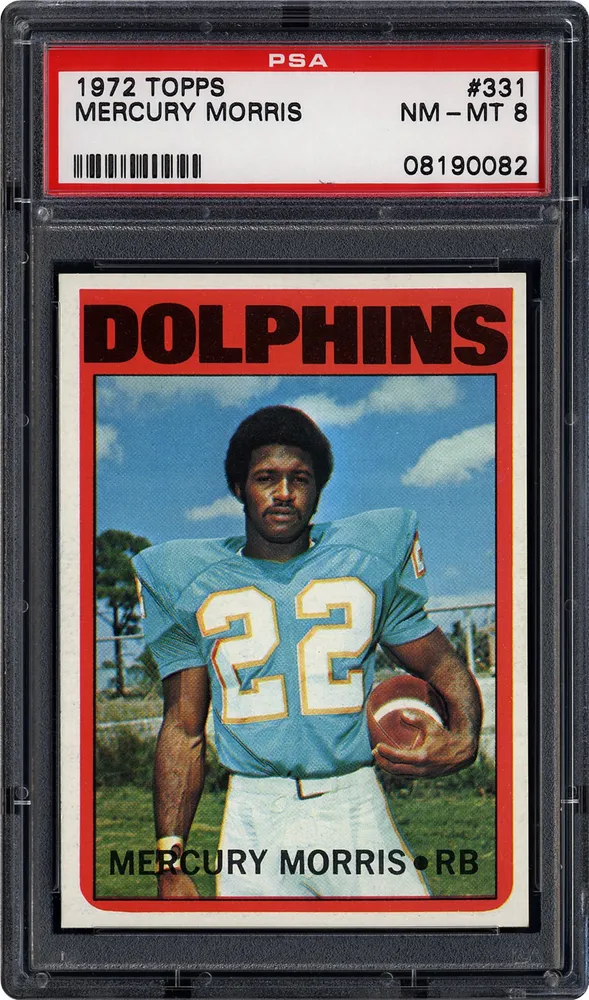
Mercury Morris #331 card
#331NM-MT 8

Mercury Morris

Notable Miami Dolphins running back from the third series, part of the 1972 perfect season roster. The red Dolphins frame is one of the brighter team treatments in the set.

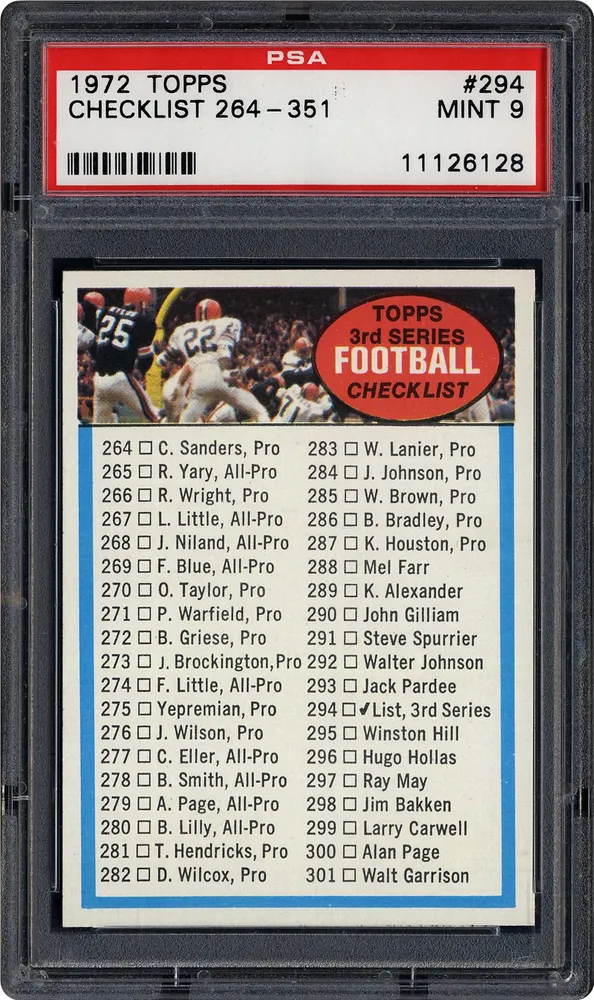
Third Series Checklist #294 card
#294MINT 9

Third Series Checklist

Scarce checklist covering #264–351, especially difficult to find unmarked. Collectors ticking boxes in pencil is why clean examples are so rare.

The case for the set

What makes 1972 Topps Football collectible?

The appeal comes down to three things: its rookie class, its historical significance and its third-series scarcity.

The rookie lineup includes Roger Staubach, John Riggins, Ted Hendricks, Ron Yary, Gene Upshaw, Larry Little and Charlie Joiner. The veteran checklist adds legends such as Namath, Sayers, Bradshaw, Unitas, Butkus and Tarkenton.

The set also represents a turning point in Topps football card production. It introduced leader cards and Pro Action cards, while its three-series distribution made it the final vintage Topps football set of its kind.

For collectors, the third series adds another layer of difficulty. Finding all 351 cards is one challenge. Finding them with strong centering, clean surfaces and sharp corners is another.

Condition and high-grade collecting

Centering, rough cuts and the last card in the set

Condition is a major part of the 1972 Topps collecting experience. Even cards that appear relatively clean can have flaws that make high-grade examples difficult to find.

Centering: poor centering affects many cards, particularly Roger Staubach #200 and Rayfield Wright #316.

Print defects: factory printing dots, ink smudges and plate marks appear throughout the set.

Rough cuts: dull cutting blades contributed to uneven card edges.

Checklist condition: the third-series checklist is especially difficult to find without marks.

Last-card wear: Ken Willard #351 is considered one of the toughest cards to find in high grade because of the wear often associated with the final card in a set.

The Staubach rookie is particularly challenging. Its position on the original printing sheet may have contributed to centering problems. The #351 Ken Willard card is another major condition challenge, making it an important target for collectors pursuing a high-grade complete set.

Design and card features

Simple layout, distinctive photography

The 1972 Topps design is relatively simple, but its photography gives the set a distinctive look. Each card features a posed player photograph in either a horizontal or vertical format, surrounded by a thin border that incorporates team colors.

Horizontal cards place the team name along the left side of the image, while vertical cards position it at the top. The player's name and position appear along the bottom. The card backs include biographical information, statistics and a cartoon illustration.

One unusual feature is the absence of most team logos, likely due to licensing limitations. The photography, however, is a major strength of the set, with collectors often pointing to the sharp images and strong player portraits.

The third series

What makes the set difficult

The defining challenge of the 1972 Topps Football set is its third series, covering cards #264–351.

The first two series were distributed through a wider range of products, including wax packs, rack packs, cello packs and vending boxes. The third series was released in much smaller quantities and was reportedly distributed in only select parts of the country.

Its late-season release may have also contributed to its scarcity. By the time the third series arrived, collectors were accustomed to Topps football sets having two series, and the next year's cards were already approaching.

The result is a high-number run that can be difficult to complete, particularly in high grade. The third series includes several important cards, including the Joe Namath Pro Action card, Steve Spurrier's rookie and Rayfield Wright's rookie.

Subsets and special cards

Leaders, Pro Action, Playoffs and All-Pro

The 1972 Topps set introduced several features that helped distinguish it from earlier football releases.

League Leaders (#1–8): top statistical performers, the first Topps football leader cards.

Pro Action (#119–132, #250–263, #338–351): players shown in action.

Playoffs (#133–139): highlights from postseason play.

All-Pro (#264–287): recognizes top players at their positions.

The Pro Action cards are particularly popular, especially the high-number examples. Joe Namath's #343 is one of the most sought-after cards in the set, while the Dick Butkus Pro Action card #341 is another notable third-series issue.

Collecting tips

Building a 1972 Topps collection

Secure the third series first. #264–351 is the bottleneck, and waiting rarely helps.

Buy Staubach #200 and Rayfield Wright #316 on centering, not on grade alone.

Check Pro Action high numbers carefully. #341 and #343 are the two most demanded cards in that run.

Avoid marked checklists. A clean third-series checklist is one of the harder pieces of the set to source.

Treat Ken Willard #351 as a separate project. Final-card wear makes clean copies genuinely scarce.

Final take

The 1972 Topps Football set is a landmark vintage release with one of the strongest combinations of rookie cards and established stars from its era. Roger Staubach's rookie anchors the checklist, but the depth of Hall of Fame talent makes the set rewarding well beyond its biggest card.

Its third-series scarcity, distinctive photography and place in Topps history give it lasting appeal. Whether collecting individual rookies, building a Hall of Fame player collection or pursuing the complete 351-card checklist, 1972 Topps Football remains an important set for vintage football collectors.

We use cookies

Players Invest uses essential cookies to run the site, plus analytics and advertising cookies to understand how visitors use it and to measure our marketing. You can accept or decline the non-essential ones. Privacy Policy